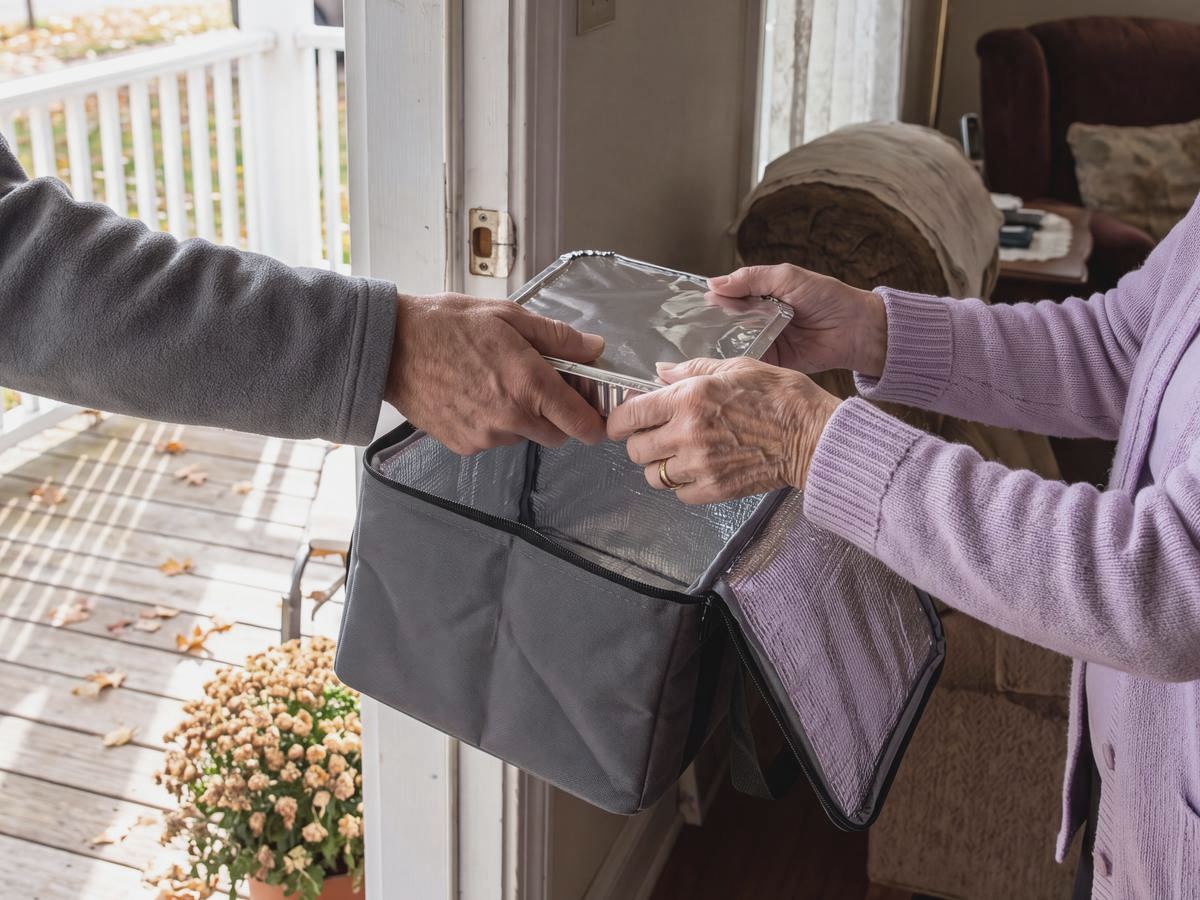
Your mother's first delivered meal arrives on a Tuesday. You set it up from three hours away after your sister mentioned the empty fridge, and that afternoon your mother calls to tell you about the soup.
She hadn't told anyone she'd stopped cooking. Your sister only found out because she opened the fridge.
What are the signs my parent needs help at home?
Look at the ordinary things: what's in the fridge, whether the laundry gets done, how your parent manages the stairs and the bath, and whether there's been a fall.
From far away, you see your parent's home a little at a time: what's behind them on a video call, what they mention in passing, and what the person nearby notices on a visit.
Ask about falls directly. More than one out of four older people falls each year, but less than half tell their doctor, according to the CDC.
The script for asking:
Have you slipped or had a fall since we last talked, even a small one?
Is anything in the house harder to do than it was last spring?
What would you like a hand with?
For what to watch over an ordinary week, see how to tell how much help your parent needs.
What help can my parent get at home?
Help at home can mean someone who brings meals, cleans, or helps your parent bathe and dress. It can also mean a nurse or therapist who visits, someone who makes the house safer, or a day program where your parent spends time with others.
Start with what you've seen at your parent's home. Each row shows the kind of help to ask for, and the country tables below show who to call.
| What you've seen | Help to ask for |
|---|---|
| Little food in the fridge, or meals being skipped | Home-delivered meals, grocery delivery, or homemaker help with shopping and cooking |
| Laundry, cleaning, or shopping falling behind | Homemaker help with housework and shopping |
| Trouble bathing, dressing, or getting out of bed | Personal care from a home care aide |
| Home after a hospital stay, a new wound, or new trouble getting around | Home health care: a visiting nurse, or physical or occupational therapy |
| A fall, or trouble with the stairs or getting in and out of the tub | Home safety changes: grab bars, a second handrail, better lighting, a walker |
| Yard work, snow, or repairs left undone | Chore help, or a local handyperson |
| Your parent is alone most of the day, and lonely or unsafe | An adult day program, or a regular companion visit |
| The person nearby who does most of the care needs a break | Respite care: an aide at home or a day program, for a few hours or days |
Where to ask in the US
| Help | Who to call |
|---|---|
| Meals | Meals on Wheels America (find by ZIP code), or the Area Agency on Aging through the Eldercare Locator, 1‑800‑677‑1116 |
| Help around the house | The Area Agency on Aging. If your parent has Medicaid, ask about the state's home care waiver. |
| Bathing and dressing | The Area Agency on Aging, the state's Medicaid home care waiver, or PACE where it's offered |
| Nursing and therapy at home | Your parent's doctor, or the hospital before discharge. Medicare pays for home health care if your parent qualifies. |
| Safety changes at home | See the home safety list below |
| Yard work, snow, and repairs | Rebuilding Together; the city's seniors' snow shoveling program, if it has one (call 311) |
| Company during the day | The Senior Companion Program, where one runs locally (ask the Area Agency on Aging), or an adult day program |
| A break for the caregiver | The Area Agency on Aging, which runs the National Family Caregiver Support Program, or the ARCH National Respite Locator |
| If your parent is a veteran | VA homemaker and home health aide care, Veteran-Directed Care, adult day health care, and respite. VA Caregiver Support Line: 1‑855‑260‑3274 |
Where to ask in Canada
| Help | Who to call |
|---|---|
| Meals | Local Meals on Wheels; in Quebec, popotes roulantes. Elsewhere, call 211. |
| Help around the house | The province's home care program. BC: Better at Home. Nova Scotia: the Seniors Care Grant. Quebec: the RAMQ domestic help program. |
| Bathing and dressing | The province's home care program. Ontario: Ontario Health atHome, 1‑833‑515‑1234. BC: the regional health authority, or 8‑1‑1. Alberta: 811. Quebec: the local CLSC. Nova Scotia: 1‑800‑225‑7225. |
| Nursing and therapy at home | The province's home care program, or the hospital before discharge |
| Safety changes at home | See the home safety list below |
| Yard work, snow, and repairs | The city's seniors' snow program, if it has one (Halifax and Kitchener do). BC: Better at Home. Alberta: Special Needs Assistance for Seniors. Quebec: the home-support tax credit, for people 70 and older. |
| Company during the day | Ontario: A Friendly Voice, 1‑855‑892‑9992. Quebec: Les Petits Frères (75 and older). BC: Better at Home friendly visits. Adult day programs through home care. |
| A break for the caregiver | Respite through the home care program. Caregiver helplines: Ontario 1‑833‑416‑2273, BC 1‑877‑520‑3267, Quebec 1‑855‑852‑7784. |
| If your parent is a veteran | Veterans Affairs Canada's Veterans Independence Program (housekeeping, grounds upkeep, personal care), 1‑866‑522‑2122, or the Royal Canadian Legion's Poppy Fund |
Where to ask in the UK
| Help | Who to call |
|---|---|
| Meals | The council's community meals, after a needs assessment, or your parent's local Age UK |
| Help around the house | The council's needs assessment (councils may not help with housework), or paid help at home from the local Age UK |
| Bathing and dressing | Adult social services at the council (in Northern Ireland, the Health and Social Care Trust). In Scotland, personal care is free if your parent is assessed as needing it. |
| Nursing and therapy at home | The hospital before discharge, or the GP. In England, help to recover at home is free for up to six weeks. |
| Safety changes at home | See the home safety list below |
| Yard work, snow, and repairs | A home improvement agency, called Care and Repair in Scotland and Wales, or an Age UK handyperson service |
| Company during the day | The Silver Line, 0800 4 70 80 90, free and open 24 hours. Age UK telephone friendship. Re-engage (75 and older). Day programs through the council. |
| A break for the caregiver | A carer's assessment from the council (in Northern Ireland, the Trust). Carers UK: 0808 808 7777. |
| If your parent is a veteran | Royal British Legion, 0808 802 8080; SSAFA, 0800 260 6780; VALOUR, 0808 1914 218 |
Can't find what you need in the tables?
Some of the most useful help is run by a city or a local charity, so no national list has it. Search for it this way:
[what you need] for seniors in [town], [state, province, or county]
For example, “snow removal for seniors in Kitchener, Ontario” or “foot care nurse home visits Halifax.” Adding “city of” or “council” brings up official pages first. Trust results from the city, the state or province, the council, or a charity, and be careful with sites that ask for your phone number before they show you anything.
Or paste this into a chat assistant like ChatGPT, with your own details:
My [mother] lives in [town, province]. [She] needs [help getting groceries and someone to clear snow]. List free or low-cost services from the government, the city, and charities, with each one's phone number and website, who qualifies, and how to apply. Only include services you can link to.
Call to confirm before you count on anything the assistant finds. Phone numbers and programs change, and chat assistants can give out-of-date details.
How do I make my parent's home safer to prevent falls?
Go room by room with a home safety checklist. Your family can do many of the fixes, like nightlights and anti-slip treads. Others, like grab bars and handrails, need someone to put them in, and there's help with finding that person and with the cost.
The National Council on Aging's Home Safety Checklist (2026) is two pages. It marks each fix as one your family can do, one for a contractor, or one to check with an occupational or physical therapist. Its main fixes:
- Stairs: Keep things off the stairs, and add anti-skid strips to the edges of the steps, in a shade that stands out. Have handrails put in on both sides, and light switches at the top and bottom.
- Bathroom: Put adhesive anti-slip treads on the tub and shower floor. Have grab bars put in around the tub or shower and by the toilet, and ask about a shower seat and a hand-held shower head.
- Bedroom: Keep glasses and a lamp within reach of the bed, put nightlights on the path to the bathroom, and keep a sturdy chair to sit on while dressing.
- Floors: Remove or secure throw rugs, clear clutter from walkways, and clip or tape cords to the wall or floor.
- Kitchen: Move what your parent uses often to between shoulder and hip height, and use a sturdy step stool with a bar to hold.
Walk through the house with your parent, one room at a time, or send the checklist to whoever visits next. They can take care of the easy fixes, like nightlights and treads, on that visit.
For the rest:
- A therapist's visit: an occupational therapist can watch how your parent moves around the house and recommend changes and equipment. Ask your parent's doctor for a referral to an occupational therapist.
- In the US: ask the Area Agency on Aging about help with changes to the home. Rebuilding Together's Safe at Home program puts in grab bars, handrails, and ramps for older adults at no cost, where a local affiliate offers it. Veterans may qualify for a VA grant for changes to the home.
- In Canada: the federal Home Accessibility Tax Credit covers part of the cost of changes for someone 65 or older. Some provinces help with the cost too, such as BC's Rebate for Accessible Home Adaptations, Manitoba's Safe and Healthy Homes for Seniors, and Nova Scotia's Housing Repair and Accessibility Program, all for lower-income households.
- In the UK: the council's needs assessment can lead to equipment and changes to the home. In England, small changes under £1,000 are free if your parent is assessed as needing them. Bigger changes may qualify for a means-tested Disabled Facilities Grant. Home improvement agencies, called Care and Repair in Scotland and Wales, offer handyperson help.
How do I find in-home care services near my parent?
Start with the free public program where your parent lives. The tables above have the numbers. For smaller jobs, like nail care or a hairdresser who visits, ask that program or a local charity for names. Before a new helper's first visit, call their references and ask for a background check.
In Canada and the UK, the public program starts with an assessment of what your parent needs. In Canada, that's the province's home care program: Ontario Health atHome, a BC health authority, Alberta's 811, a Quebec CLSC, or Nova Scotia Continuing Care. In the UK, it's the council's adult social services in England, Scotland, and Wales, and the Health and Social Care Trust in Northern Ireland. In the US, start with the Area Agency on Aging. Ask your parent before you call, and have them on the line if you can.
One caregiver we interviewed described the search for the right person:
“When you need to bring somebody in, finding that person to cut the nails, or a hairdresser who makes house visits, or someone to keep dad company for a couple hours so mom can go grocery shopping, how do you find that person? How do you vet that person?”
- Foot care: In the US, Medicare usually doesn't pay for routine nail trimming. Ask the Area Agency on Aging about a foot care nurse or clinic nearby, because some come to the home. In Canada, the Canadian Association of Foot Care Nurses lists foot care nurses. In the UK, NHS podiatry is mainly for people whose feet are at high risk, and some local Age UKs offer toenail cutting, a few at home.
- A hairdresser who visits: No government program arranges this. Ask the local aging service, a community support agency, or the local Age UK for names, or search “mobile hairdresser for seniors in [town].”
- Someone to keep your parent company: Volunteer visiting programs are in the “Company during the day” row of each table above.
Checking the person before they start:
- Ask for two or three references, and call them.
- In the US: ask the agency or the person for a background check, and check your state's registry of home care aides, if it has one.
- In Canada: some provinces have a public register of care aides, such as Ontario's (joining is voluntary, so not being listed isn't a warning sign), Alberta's, and Nova Scotia's. If you hire someone yourself, ask them for a recent police record check.
- In the UK: if you hire someone yourself in England or Wales, you can't request the criminal record check. Ask the worker to show you their own DBS certificate. Agencies are inspected and rated by the CQC in England, the Care Inspectorate in Scotland, Care Inspectorate Wales, and the RQIA in Northern Ireland.
If free services don't cover enough hours, a private home care agency can send an aide or a companion for the hours you choose. The questions to ask an agency are in the FAQ below. For a paid care manager who can assess your parent's needs and arrange help, see how to help from far away.
Who pays for help at home?
In the US, Medicare pays for nursing and therapy at home, but not for daily help on its own. In Canada, provinces pay for home care if your parent qualifies, with fees for some services. In the UK, it depends on where your parent lives and how much they have in savings.
In the US, Medicare pays for home health care when your parent's doctor confirms they need part-time skilled nursing or therapy. Your parent must also be homebound, meaning leaving home takes a lot of effort. Your parent pays nothing for covered home health services. Medicare doesn't pay for 24-hour care at home, home meal delivery, homemaker services like shopping and cleaning that aren't part of the care plan, or personal care when that's the only care your parent needs. While your parent gets nursing or therapy at home, Medicare can also pay for an aide to help with bathing and dressing. It won't pay for someone to help your parent shower every morning if that's all they need.
If your parent has Medicaid, ask the Area Agency on Aging about the state's home and community-based services, which pay for some care at home instead of in a nursing home. Otherwise, families pay an agency themselves, or use long-term care insurance if your parent has a policy. If your parent is a veteran, the VA may pay for a home health aide or homemaker, sometimes with a copay.
In Canada, each province pays for home care if your parent qualifies, and some charge for parts of it. In Ontario, the government pays for nursing, therapy, and personal support like help with bathing and dressing. Homemaking is included only with personal support, or when your parent needs supervision because of memory problems, and community support services like meal programs may charge a fee. In BC, home support costs a daily rate based on income, with no charge for people who get the Guaranteed Income Supplement. In Saskatchewan and Nova Scotia, nursing at home is free, and homemaking and home support have fees based on income. Veterans may get help with the cost through Veterans Affairs Canada's Veterans Independence Program.
In England, the council works out what your parent pays with a financial assessment. Someone with savings over £23,250 usually pays for their own care, though some councils set a higher limit for care at home. In 2024, the NHS put the cost of a paid carer at £15 to £30 an hour, depending on where your parent lives.
In Scotland, personal care is free for anyone assessed as needing it, whatever their age or savings. Councils may charge for help like housework and shopping. In Wales, the most anyone pays for care at home is £100 a week. In Northern Ireland, ask the Health and Social Care Trust about charges.
This is a summary, based on Medicare's home health services page, Ontario's home care page, BC's home support page, the NHS guide to paying for your own care, Scotland's free personal care guide, and the Welsh Government's charging for social care page. Rules and amounts change. Check with Medicare, the province, or the council before you plan around them.
What if home care isn't working?
Start by writing down every missed, late, or short visit. That record is what gets the agency, the care coordinator, or the council to act. If that doesn't fix it, each country has a next step.
Aides miss visits, run short, or change from week to week, and waits can be long. In a 2023 survey by BC's Office of the Seniors Advocate, 36% of home support clients had five or more different workers in a typical week. 44% said a cancelled visit was usually not, or never, made up.
This part is hard, and nothing matters more than getting it right. Once the pieces are in place, you'll be glad you kept at it.
- Get the plan in writing. Ask for a copy of the care plan and the visit schedule: what the aide does on each visit, and for how long. Ask what happens when a visit is missed, and who covers. Medicare home health patients have a right to a copy of their care plan. In England, the council must send a copy of the plan to anyone your parent asks it to, which can be you.
- Keep a log. For each problem visit, write down the date, when the visit was meant to happen, when the aide arrived and left, who came, what was and wasn't done, and who you told. A log gives the supervisor something specific to act on.
- Have a backup for no-show days. Line up someone nearby who can stop by on visit days, keep the agency's after-hours number handy, and set up a simple way for your parent to tell someone the aide didn't come.
- Raise it early, then go up a level.
- In the US: start with the agency's supervisor. For Medicare home health, the next step is the state home health hotline, which the agency should give you at the start. If Medicaid pays, talk to the case manager. If Medicaid cuts your parent's hours, ask for a fair hearing before the date on the notice, which usually keeps the hours in place while you wait. In some states, the long-term care ombudsman also helps people who get care at home, and the Area Agency on Aging can tell you.
- In Canada: in Ontario, go to the care coordinator, then make a formal complaint to Ontario Health atHome, which must answer within 60 days. If the hours are too few, you can appeal to the Health Services Appeal and Review Board, and the Patient Ombudsman is at 1‑888‑321‑0339. In BC, go to the manager, then appeal within the health authority, then the Patient Care Quality Office. In Alberta, go to the manager, then the Continuing Care Licensing Office. In Quebec, go to the complaints commissioner at the CISSS or CIUSSS, then the Protecteur du citoyen.
- In the UK: complain to the provider first, then to the council if it arranged or pays for the care. In England, the council must review the care plan when you or your parent reasonably ask, and it can't use a review to cut care without good reason. After that comes the Local Government and Social Care Ombudsman.
How do I build a care team so I'm not doing everything alone?
Agree on who does what and when: the aide's tasks, each family member's jobs, and anyone else who helps. Then keep everyone's updates in one place.
Help at home adds people. The aide comes Tuesday and Friday, the meal arrives at noon, your brother takes Saturdays, and you handle the bills and the agency from where you live. None of them sees what the others did that week.
Elderella gives the whole care team one place. Anyone in the family can set it up, including you. Invite each person by phone number and choose what they can see: a Contributor sees only what they added or what's assigned to them, which suits an aide or the person next door. Send an elder briefing with the invitation, so a new aide knows your parent's care needs and preferences from day one. Then ask each person to take on a task with a due date and reminders, like “Pick up the prescription Friday.” See how the care team works.
If you're doing this on your own, adding even one helper makes a difference. Ask someone who lives near your parent whether they'd look in once a week.
What if I'm caring for my husband or wife?
Everything in this article applies to a partner too. The difference is that you live there, so the help comes into your own home, and there's support meant for you as the person doing the care.
When you care for a partner, you're the person nearby. No one takes over at the end of the day, and getting out for a few hours means arranging for someone to be there. That makes respite, the “A break for the caregiver” row in your country's table, a good place to start.
Support for you as the caregiver:
- In the US, the National Family Caregiver Support Program offers respite, counseling, training, and support groups to family caregivers of people 60 and older. Reach it through the Eldercare Locator at 1‑800‑677‑1116.
- In Canada, several provinces have a caregiver helpline: the Ontario Caregiver Organization (1‑833‑416‑2273, 24 hours a day), Family Caregivers of BC (1‑877‑520‑3267), and Info-aidant in Quebec (1‑855‑852‑7784, in French or English). Elsewhere, call 211.
- In the UK, ask your council for a carer's assessment. It's free, it's separate from your partner's needs assessment, and it can lead to someone taking over the care so you can take a break. Carers UK's helpline is 0808 808 7777.
Family who live farther away can still help. Ask them to handle the calls to agencies, the appointment bookings, or the bills.
Frequently asked questions
What's the difference between home care and home health care?
Home care is everyday help: meals, housework, bathing, dressing, and company. Home health care is medical care at home, like a visiting nurse or a physical therapist, ordered by your parent's doctor. In the US, Medicare pays for home health care when your parent is homebound and needs part-time skilled care, but not for home care on its own. In Canada, provinces pay for both if your parent qualifies, with fees for some services. In the UK, a needs assessment from the council, or the Health and Social Care Trust in Northern Ireland, is the way into help with daily living, such as a paid carer.
Can I arrange help at home for my parent from another city?
Yes. You can call the public program for your parent's area from anywhere: the Eldercare Locator in the US at 1-800-677-1116, the province's home care program in Canada, or your parent's council in the UK (in Northern Ireland, the Health and Social Care Trust). Ask your parent first, and have them on the line if you can, because the help is theirs to accept. Ask someone nearby to be there for the first visit, and ask for every visit schedule by email.
How do I check a home care agency before I hire it?
Ask how the agency screens and trains its aides, whether they're its employees, who covers when an aide is sick, and who to call when a visit is missed. Get the visit schedule in writing, and the name of the person who supervises the aides. In England, agencies that help with personal care must register with the Care Quality Commission, which publishes inspection reports. In the US, ask the Area Agency on Aging which agencies it works with. In Canada, ask the province's home care program.
How long does it take to get home care?
It depends on where your parent lives and what they need. In Canada, half of people wait a few days for home care, and 1 in 10 waits about a month, according to the Canadian Institute for Health Information (2024–25). In England, 372,113 people were waiting for an assessment, care, or a review in March 2025 (ADASS). In the US, 40 states had waiting lists for Medicaid home care in 2024 (KFF). Call early, before a crisis, and ask how long the wait is.