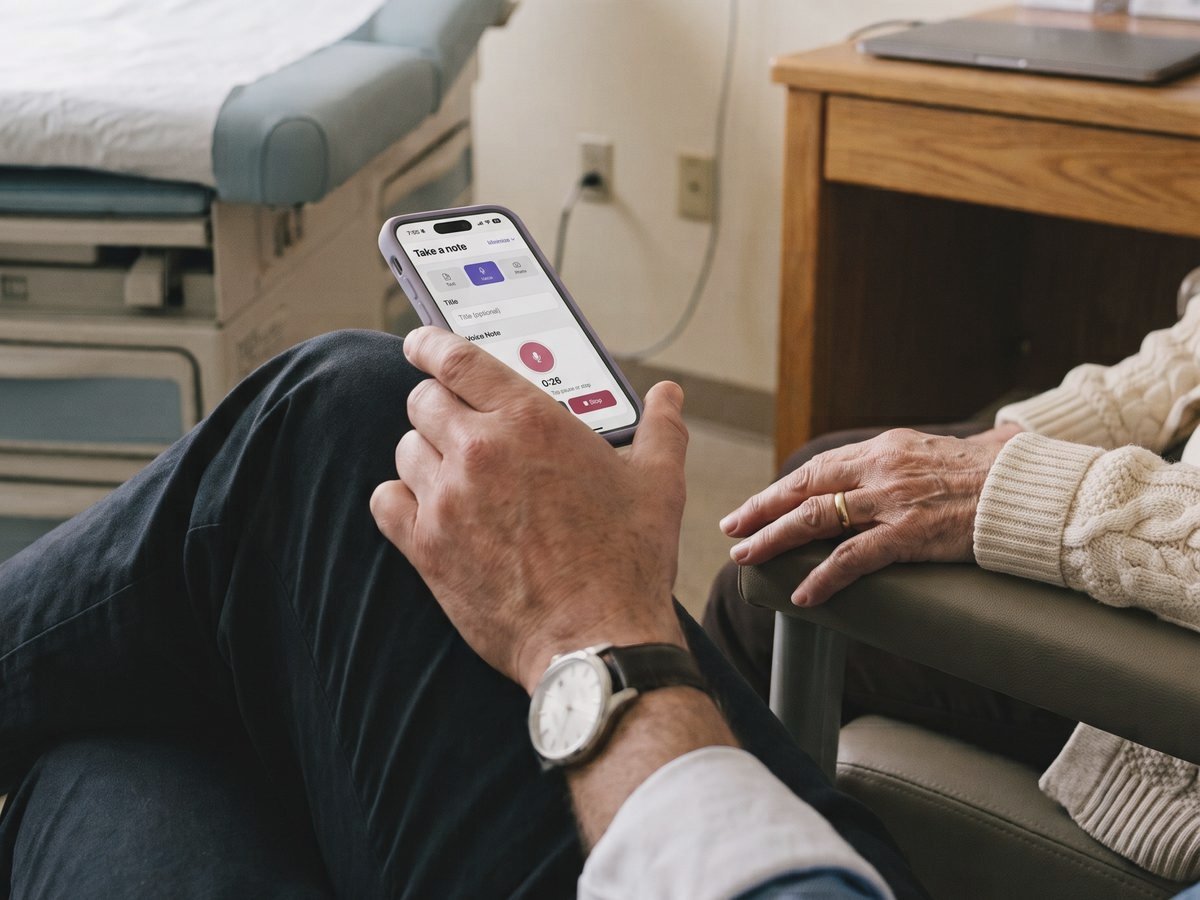
A doctor gives you three new instructions, a dose change, and a word you have never heard, all in about ninety seconds. By the time you reach the car, half of it is gone. If you help care for a parent, you may not even be in the room. You are getting the story secondhand, over the phone, hours later.
Recording the visit keeps the exact words. Your brother, or your grown kids, can hear the cardiologist say it instead of your retelling. First, a fair question: are you allowed to?
What is the one rule that decides whether I can record?
Almost every recording law asks one question: how many people in the conversation have to agree to the recording, one of you or everyone.
- One-party consent. One person in the conversation agrees to the recording, and that person can be you. The law does not make you tell the doctor.
- All-party consent (sometimes called two-party). Everyone in the conversation agrees. Here you ask the doctor first.
Both rules protect private conversations, the kind where people expect not to be overheard. A medical appointment is a private conversation.
How do I ask so the doctor says yes?
Ask at the start, tell the doctor why, and have a fallback ready. The reason to give: you want to remember the instructions and share them with the family who help.
The ask
The script for asking:
“I'd like to record this so I remember your instructions and can share them with my family who help with care. Is that alright?”
If the doctor says no:
“Of course. Could I record just the instructions at the end? Or I'll take notes and read them back to you, to check I have them right.”
Where to put the phone: where the doctor can see it, not in a pocket, and not running in the waiting room, where it can pick up other patients.
You are not the first to ask. In a 2017 US survey by Dartmouth researchers, nearly one in five people had recorded a clinic visit, and two in three said they would (Journal of Medical Internet Research, 2018).
A doctor who finds out later that they were recorded may trust you less, and you will see this doctor again. And some clinics don't allow recording. Asking first means you find out before you press record.
Which US states need everyone's agreement for a visit in the room?
Ten states require everyone's agreement or notice, four more are unclear enough that you should ask, and everywhere else your own consent is enough.
US federal law sets a floor of one-party consent: you can record a conversation you are part of. States can go further, and these do.
Everyone must agree, or be told: California, Florida, Illinois, Maryland, Massachusetts, Montana, New Hampshire, Oregon, Pennsylvania, and Washington.
In Montana and Oregon the rule is notice: everyone in the room has to know the recording is happening.
Four more states have laws that conflict with each other, or that courts read two ways, so ask there too: Delaware, Hawaii, Michigan, and Missouri.
Everywhere else in the US, and in Washington, DC, the rule for a conversation in the room is one-party consent.
Check this where you live. We compiled this summary from the Reporters Committee for Freedom of the Press recording guide, a non-profit legal resource written for journalists. Some of its state pages date from 2019. Laws change, and the rule where you are is yours to check before you rely on it.
What about HIPAA? HIPAA does not apply to you. Its rules cover doctors, clinics, hospitals, and health insurers. A patient or a family member recording their own visit is none of those. Your right to record turns on your state's consent law.
What are the rules in Canada?
In every province you can record a private conversation you are part of, so the Criminal Code's one-party rule covers your own appointment.
Section 184 of the Criminal Code makes it an offence to record a private conversation, with one exception that matters here: the person recording has the consent of someone in the conversation. When you are in the conversation, that someone is you.
The line you cannot cross is recording a conversation you are not part of, like leaving a phone running in a room you have left. That is a criminal offence, with a penalty of up to five years.
A doctor can still say no. The Canadian Medical Protective Association tells doctors that a patient may record without their consent, and that a doctor who declines a request should say why and carry on with the visit. Ontario's regulator asks doctors to note any recording in the medical record.
Recording rules at a glance
| Where you are | Can I record my own visit? | What is required | Can the doctor record me? |
|---|---|---|---|
| US, the ten states above | Yes, if the doctor agrees | Everyone in the room agrees, or is told | Yes, with your consent |
| US: Delaware, Hawaii, Michigan, Missouri | Ask first | The law is unclear or conflicting | Yes, with your consent |
| US, everywhere else, and Washington, DC | Yes | Your own consent | Yes, with your consent |
| Canada, every province | Yes | Your own consent (Criminal Code s. 184) | Yes, with your consent |
A summary, not legal advice. A clinic can set its own policy on top of the law.
Can I record my parent's appointment?
Yes, if you are in the room or on the call, because that makes you part of the conversation. If you are not, your parent records, and their yes matters.
Sitting beside your parent or your partner in the exam room, or on speakerphone from another city, you are part of the conversation. The rules above apply to you the same way they apply to the patient.
When you are not there, the recording is your parent's to make. Ask them first, the same way you would ask the doctor. Your parent decides who hears what the doctor said.
If your parent is the one recording, the ask is the same script with one word changed: “my daughter,” “my son,” or “my wife” instead of “my family.”
Can I record a phone or video appointment?
Mostly the same rules apply, but two states are stricter on the phone than in the room, and the video platform may add a notice of its own.
Nevada allows one-party recording for a conversation in the room and requires everyone's agreement for a phone call. Connecticut is one-party in the room, but on a phone call, anyone you record without their agreement or a recorded notice can sue you. Oregon is the reverse: everyone must be told in the room, and one party is enough on the phone.
A video platform may show its own recording notice or have a recording button of its own. Ask at the start of the call, the same as in the room.
Can the doctor say no, or record me?
Yes to both. A clinic can set its own policy and decline, and a doctor who records you needs your consent and has more rules to follow than you do.
A doctor who says no is within their rights even where the law is on your side. Canadian doctors are advised to ask what you hope to get from the recording and look for another way to give it to you. If the answer is no, ask for that other way: a written summary, or a minute to read your notes back.
In the other direction, a doctor or clinic that wants to record you needs your agreement, and in the US, HIPAA governs how they store and protect the recording. If the clinic records visits to write up its notes, you can ask, and you can say no.
What do I do with the recording afterward?
Listen to it once, note what changed, and share the recording with the people helping with care, never publicly.
Most people do listen. Across 33 studies of patients given a recording of their visit, 72% listened to it, and in most of the studies patients shared the recording with others (a 2014 review in Patient Education and Counseling).
Note what changed, however you keep track: a new medication or dose, a test to book, a date to come back, and anything the doctor asked for that is not medical, like a ride or a form. The caregiver notes guide has a template.
Sharing the recording with your brother or the aide is what it is for. Posting it, or using it against the doctor, is where privacy and other laws come in.
What to record with: Voice Memos on an iPhone works. The recorder on an Android phone works. Elderella works.
What about the calls I'm not on?
You cannot record a conversation you are not part of, and much of a parent's care happens on calls like that.
Everything so far is about a conversation you are part of: a visit you attend, or a call you are on. But much of care happens on calls you are not on. The doctor phoning your parent with test results. The pharmacist checking a dose. The bank calling about a charge on the card.
That gap is what call protection in Elderella is for. Your parent gets a dedicated care phone number. Calls to it are recorded and transcribed, so what the doctor, pharmacist, or bank said is captured and searchable, and the whole care team can catch up, even on the calls no one in the family was on.
Frequently asked questions
Is it legal to record my own doctor's appointment?
In most of the US and everywhere in Canada, yes. Ten US states require everyone in the room to agree or be told, four more are unclear enough that you should ask, and everywhere else your own consent is enough. Check the rule where you live before you rely on it.
Which US states require the doctor's consent to record?
For a visit in the room: California, Florida, Illinois, Maryland, Massachusetts, Montana, New Hampshire, Oregon, Pennsylvania, and Washington. Ask in Delaware, Hawaii, Michigan, and Missouri too, where the laws conflict or are read two ways, and in Nevada and Connecticut for phone calls. These laws change, so check the current rule where you live.
Does HIPAA stop me from recording my own visit?
No. HIPAA's rules cover doctors, clinics, hospitals, and health insurers, not patients or family. Whether you can record depends on your state or province's consent law, and on the clinic's own policy.
Do I have to tell the doctor in a one-party state?
The law does not require it. Ask anyway. It takes ten seconds, it keeps the relationship intact, and if the clinic doesn't allow recording, you find out before you start.
Can I share the recording with my family?
Yes. Sharing a recording of your own appointment with the people helping with care is what it is for. Posting it publicly or using it against the doctor is where privacy and other laws come in, so keep it within the care team.
What should I record with?
Any phone. Voice Memos on an iPhone, the recorder on an Android phone, or Elderella all work. Put the phone screen up on the desk or the arm of your chair, between you and the doctor, and start it after the doctor says yes.