The hospital sends your mother home with a printed list of eleven medicines. On her kitchen counter there are ten bottles. Two names on the paper aren’t on any bottle, and the bottle from the heart doctor isn’t on the paper at all.
The hospital tells you to call the family doctor. The family doctor’s office says the heart doctor changed something, and the letter should arrive in a week or two.
Nobody has the whole list. Here’s how to build one tonight, and how to keep it right when the prescriptions change.
How do I keep track of medications from different doctors?
Build the list tonight from the bottles in the house, then use this week to move everything to one pharmacy and book a review.
Tonight
- Gather every bottle, box, inhaler, eye drop, and cream your parent or spouse uses into one spot.
- Put each medicine on one list with its dose, when it’s taken, and what it’s for.
- Add the name of the doctor who prescribed each medicine.
- Add over-the-counter medicines, vitamins, and supplements to the same list.
- Put today’s date at the top of the list.
- Put a paper copy of the list in your parent’s wallet, next to the health card or insurance card.
This week
- Ask the pharmacy for a printout of every prescription filled for your parent in the past year.
- Move every prescription to one pharmacy if your parent uses more than one.
- List every drug plan your parent has, with the plan number and the phone number on the card.
- Note which medicines each plan covers and which ones your parent pays for.
- Book a medication review with the pharmacist.
- Bring the list to every appointment and ask the doctor to check the list.
The script for asking:
Here’s everything Mom takes, from all her doctors. Does anything you’re prescribing today change something on this list?
If medications are one of many new jobs this month, the caring for aging parents checklist covers the rest, from the bills to the legal documents.
What should the medication list include?
Seven things for each medicine: the name, the dose, when it’s taken, what it’s for, who prescribed it, where it’s filled, and when it started or stopped.
| On the list | What to record | Why it matters with several doctors |
|---|---|---|
| Name | The name on the label, and the other name if the pharmacist gives one | Brand and generic names can be the same medicine, and two doctors may use different names |
| Dose | The strength and how many | A doctor changing the dose needs to know today’s dose |
| When | Morning, bedtime, with food, or only when needed | “Morning” means different things to different people |
| What it’s for | The reason, in plain words | Two medicines for the same problem is a question to ask |
| Prescribed by | The doctor’s name and specialty | The office to call when something changes |
| Pharmacy | Where it’s filled, and the next refill date | Refills from two pharmacies are how lists drift |
| Started or stopped | The date, and why it stopped: a reaction, the end of a course, or a replacement | Shows the next specialist what has already been tried |
The National Institute on Aging’s advice on taking medicines safely has more on keeping the list.
Keep stopped medicines on the list, not in the cabinet. Cross them out with the date and the reason.
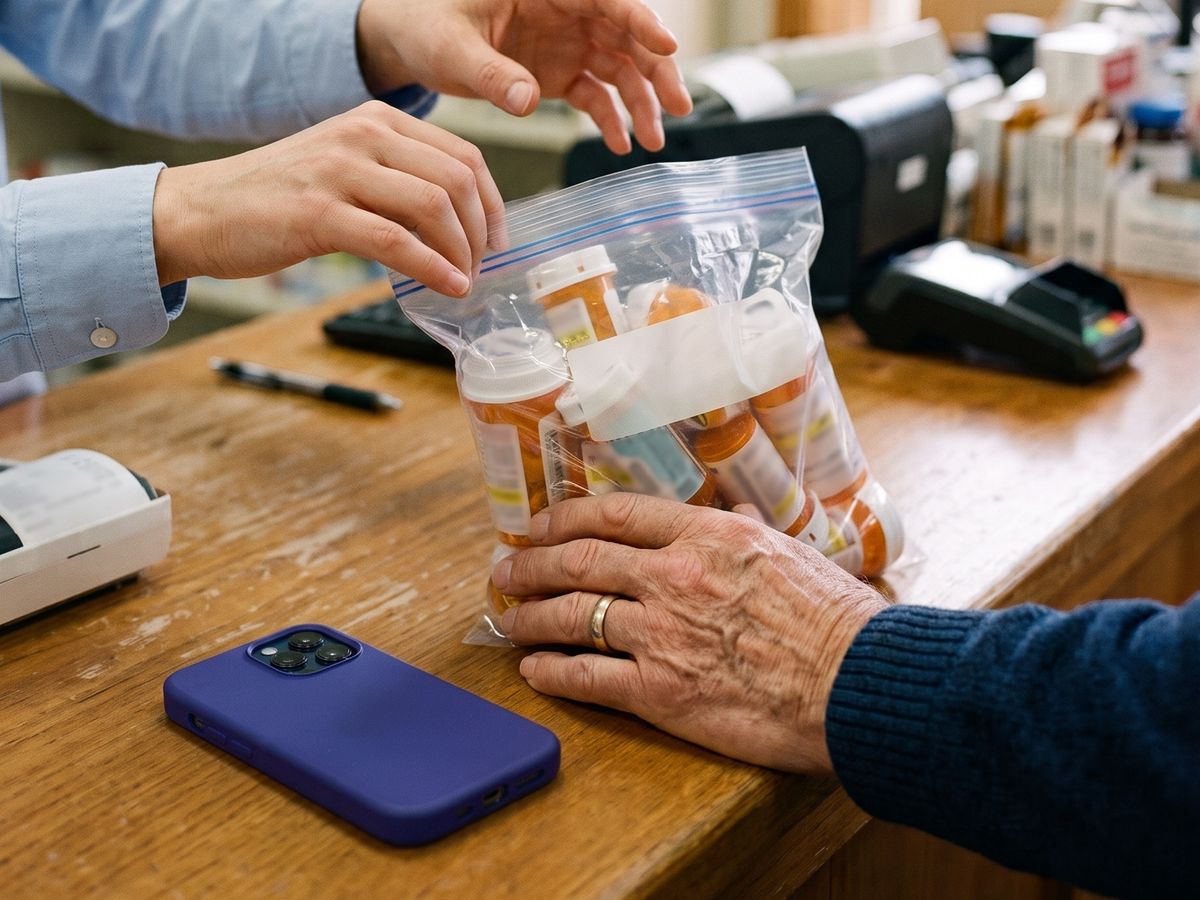
If you can’t tell which bottles are current, don’t guess and don’t throw anything out yet. Put every bottle in one bag, take it to the pharmacy with your list, and ask the pharmacist to sort the current medicines from the old ones. The pharmacy can take the old ones back for safe disposal, so the only bottles that come home are the ones on the list.
How do I find every medication my parent takes?
Search the house, ask the pharmacy for a printout, and compare the latest hospital discharge list with the bottles at home.
Medicines end up in more places than the bathroom cabinet. Check the bedside drawer, the kitchen counter, the purse, the glove box, and the fridge, where eye drops and insulin live. Look for pills that aren’t in their original bottles: a dish by the kettle, a weekly organizer, a sandwich bag. Ask your parent or spouse what they take “when they need it.” That question is where the pain relievers and the sleep aids turn up.
Then ask the pharmacy to print everything it has filled for your parent in the past year. If there are two pharmacies, ask both.
If there was a hospital stay, read the discharge summary, the papers the hospital sent home, line by line against the bottles. A medicine on the paper with no bottle is a question for the doctor or pharmacist. So is a bottle with no line on the paper.
About a third of adults aged 60 to 79 take five or more prescription drugs: 34.5% in the US and 30.9% in Canada, according to a CDC data brief comparing the two countries.
In Canada, 1 in 4 seniors was prescribed 10 or more drug classes in 2021, according to the Canadian Institute for Health Information. A drug class is a group of medicines that work the same way.
Why doesn’t each doctor know what the others prescribed?
Records don’t always travel between clinics, hospitals, and pharmacies. Each doctor sees what they prescribed, the pharmacy sees what it filled, and your list is where it all meets.
That’s why the list goes to every appointment: the family doctor, each specialist, the dentist, the eye doctor. When something new is prescribed, ask two questions. Is this replacing anything? Does it change anything else on the list?
One pharmacy helps most. When every prescription is filled in one place, the pharmacist sees all of them. The pharmacist can then spot a new medicine that might cause a problem with an old one.
Ask the family doctor to look at the whole list. The more medicines someone takes, the higher the chance of a bad reaction that ends in an emergency visit or a hospital stay, according to the Canadian Institute for Health Information. Ask whether everything on the list is still needed.
Worldwide, the World Health Organization estimates that medication errors cost US$42 billion a year.
Who can check all the medications together?
A pharmacist. In Ontario, a yearly review called MedsCheck costs nothing, and in the US, Medicare drug plans offer a similar review free to people who qualify.
In Ontario, MedsCheck is for anyone who takes three or more prescription medications for an ongoing condition, or has diabetes. It’s a free one-to-one appointment with the pharmacist, about 20 to 30 minutes, once a year. Bring every bottle, including the vitamins. If your parent or spouse can’t get to the pharmacy, MedsCheck at Home brings the pharmacist to your parent’s home.
In the US, Medicare drug plans must offer Medication Therapy Management to members who meet certain requirements. It includes a review of every medication and why your parent takes it, a written summary, and a medication list. Call the number on the drug plan card and ask whether your parent qualifies.
Anywhere else, ask the pharmacist whether the pharmacy offers a medication review and whether the drug plan pays for it.
Book the review even if the list looks fine. Among family caregivers who handle medical tasks, 8 out of 10 help with medications, and the fear of making a mistake is highest for managing medications.
How do I keep the list up to date?
Change the list the same day something changes: a new prescription, a new dose, a medicine stopped, or a discharge from the hospital.
Change the date at the top, record the date beside the change, and add a few words about why. “Dose lowered by the heart doctor, dizzy in the mornings.” The next doctor will want the reason, and so will you in six months. If you already keep caregiver notes, that line belongs there too.
Never change a dose or stop a medicine yourself to make the list match. If the list and the bottle disagree, call the pharmacy.
The list goes stale the week someone else picks up a refill. Your brother collects a prescription with a new dose, and nobody updates the list. In Elderella’s Medications, whoever picks up the refill scans the label, and Elderella fills in the name, dose, and schedule. Ella tells everyone on the care team when it changes.
Frequently asked questions
Should vitamins and supplements go on the medication list?
Yes. Over-the-counter medicines, vitamins, and supplements can interact with prescriptions, so the doctor and the pharmacist need to see every one. Write each one on the same list, with its dose.
What if my parent uses more than one pharmacy?
Move everything to one pharmacy if you can, so the pharmacist sees every prescription. If your parent or spouse has to use two, show the full list at each one when you drop off or pick up a prescription.
Can I pick up my parent’s prescriptions?
Usually, yes. In the US, privacy rules let a pharmacist use professional judgment to hand a filled prescription to a family member. In Canada, ask your parent’s pharmacy what it needs from your parent.
What do I do with medicines my parent no longer takes?
Return old medicines to a pharmacy, because Health Canada warns they may no longer be effective or could have dangerous interactions with other medications. Many pharmacies in Canada accept unused medicines for safe disposal at no charge. In the US, many pharmacies take medicines back year-round, and the Drug Enforcement Administration also holds a Take Back Day each spring and fall.
Should the list be on paper or on my phone?
Both. Keep a paper copy in your parent’s wallet for the ER, and the live list in Elderella’s Medications, where the whole care team sees the same list. Forward a discharge summary and Ella pulls out the medications for you to confirm.